
Blog
Reflective Coaching for Clarity and Confidence

There are times in life when the hardest question isn’t “What should I do?” but “Why can’t I decide?”
You might have several opportunities in front of you, but feel unable to choose. Or perhaps you’ve been thinking about making a change for months, yet every possible option feels uncertain. In these moments, confidence can seem like the missing piece.
But what if confidence isn’t actually the starting point?
One of the biggest misconceptions about personal growth is that you need confidence before you can take action. In reality, confidence often develops after you’ve gained clarity about what truly matters to you.
This is where coaching for clarity and confidence can be valuable. Rather than offering advice or telling you which direction to take, reflective coaching creates space to understand your thoughts, values, and motivations before deciding on your next step.
When you become clearer about what’s driving your uncertainty, you’re often better able to make decisions that feel authentic rather than pressured. Confidence then grows through taking thoughtful action, learning from your experiences, and trusting yourself a little more each time.
If you’re new to reflective coaching, our guide to What Is Reflective Coaching? A UK Guide to Reflection, Clarity and Personal Change explains how reflection supports meaningful personal growth.
Why Clarity and Confidence Often Feel Connected
People often say things like:
- “If I were more confident, I’d change jobs.”
- “If I believed in myself more, I’d speak up.”
- “Once I feel confident, I’ll make a decision.”
While confidence certainly helps, it’s rarely the only challenge.
Many people aren’t lacking confidence; they’re lacking clarity.
When you’re unsure about your values, priorities, or what success actually means to you, every decision can feel overwhelming. Your mind starts weighing every possible outcome, second-guessing every choice, and imagining everything that could go wrong.
Without clarity, confidence has very little to stand on.
Think about a time when you knew exactly what you wanted.
Even if the decision felt challenging, you probably found it easier to move forward because your direction was clear.
Now think about a decision where you felt completely torn.
Perhaps you worried about disappointing people, making a mistake, or choosing the wrong path.
In situations like these, the real issue often isn’t confidence; it’s uncertainty.
Reflective coaching helps slow that uncertainty down.
Instead of asking, “How can I become more confident?”, it invites questions such as:
- What matters most to me?
- What’s making this decision feel difficult?
- Which fears are based on facts and which are assumptions?
- Am I choosing from my values or from other people’s expectations?
- What would enough clarity look like today?
These questions don’t provide instant answers, but they help shift your attention from external pressure to internal understanding.
Common Reasons People Feel Stuck
Feeling stuck isn’t a sign that something is wrong with you.
It’s often a sign that different parts of you are pulling in different directions.
Some of the most common reasons people struggle with clarity include:
Fear of Making the Wrong Decision
Many people delay decisions because they’re trying to find the perfect choice.
In reality, very few life decisions come with complete certainty.
Reflective coaching encourages you to explore what “getting it wrong” actually means and whether those fears are realistic or influenced by past experiences.
Living by Other People’s Expectations
It’s surprisingly common to build a life around what you believe you should do.
Family expectations.
Career expectations.
Social expectations.
Over time, it can become difficult to recognise what you genuinely want.
Reflection creates space to separate external expectations from your own values.
Constant Busyness
When every day is filled with responsibilities, there is very little opportunity to think.
Many people move from one task to another without ever asking whether the direction they’re travelling still feels right.
Sometimes clarity doesn’t come from working harder.
It comes from slowing down.
Self-Doubt
Even when people know what they want, self-doubt can stop them from acting.
Questions such as:
- “Am I capable enough?”
- “What if I fail?”
- “What will other people think?”
Can become louder than your own intuition.
Reflective coaching doesn’t remove uncertainty altogether, but it can help you explore where those doubts come from and whether they deserve as much influence as they’ve been given.
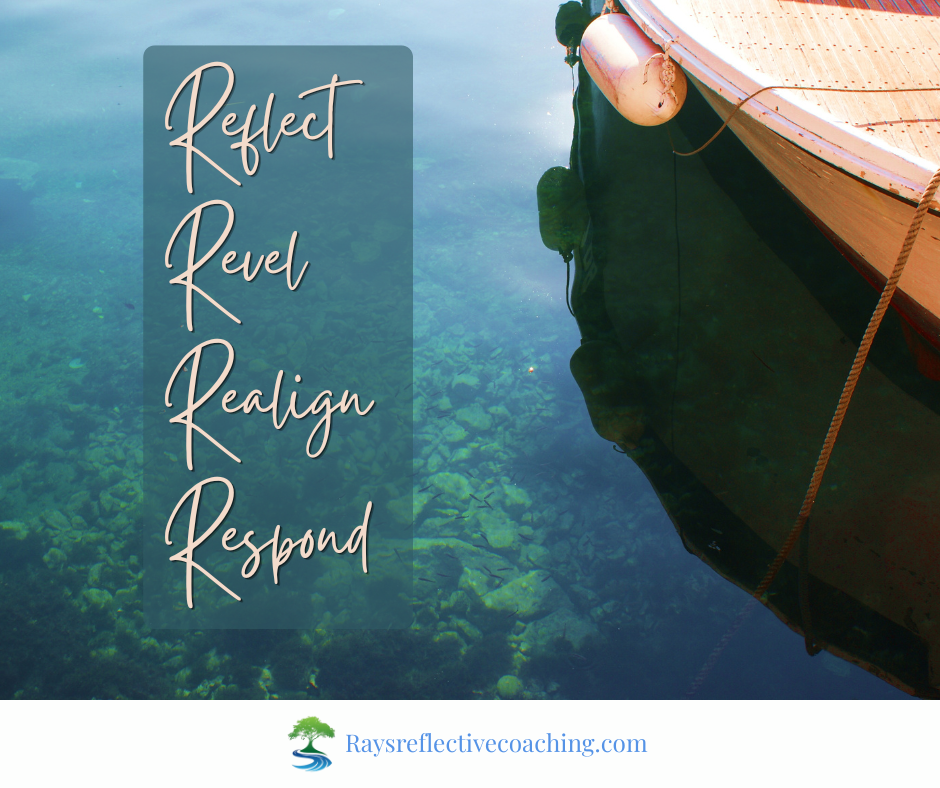
Rachel’s Reflect + Act Framework
Over the years, I’ve noticed that clarity and confidence rarely appear overnight.
More often, they develop through a process of slowing down, understanding yourself, and taking thoughtful action.
That’s why my coaching follows what I call the Reflect + Act Framework.
It isn’t a rigid formula or a checklist to complete. Instead, it’s a simple way of moving from uncertainty towards greater self-awareness and intentional action.
Step 1 – Reflect
Everything begins with creating space.
Before trying to solve a problem, I encourage clients to pause and notice what’s happening beneath the surface.
What thoughts keep returning?
What emotions are present?
What feels out of alignment?
Without this awareness, it’s easy to keep reacting to life rather than responding thoughtfully.
Step 2 – Reveal
Once we’ve slowed things down, we begin exploring the beliefs, values, and patterns influencing the situation.
Sometimes people discover they’re making decisions based on fear.
Sometimes they’re carrying expectations that no longer fit who they’ve become.
Sometimes they simply haven’t given themselves permission to ask what they really want.
This stage isn’t about judgement.
It’s about curiosity.
Step 3 – Realign
Once you’ve recognised the patterns influencing your decisions, the next step is to consider whether they still reflect the life you want to live.
This is where clarity often begins to emerge.
Realigning doesn’t always mean making a dramatic change. Sometimes it’s as simple as recognising that a decision you’ve been avoiding no longer aligns with your values. Other times, it may involve letting go of expectations that have shaped your choices for years.
During this stage, we might explore questions such as:
- What matters most to me in this situation?
- Which option feels most aligned with my values?
- What would I choose if I trusted myself a little more?
- What’s one small change that feels realistic right now?
The goal isn’t to find the “perfect” answer. It’s to identify a direction that feels authentic and manageable.
Step 4 – Respond
Insight becomes meaningful when it’s followed by action.
That action doesn’t need to be dramatic. In fact, the most sustainable changes often begin with one small, intentional step.
For one person, that might mean having an honest conversation they’ve been avoiding.
For another, it could be saying no to a commitment that no longer feels right.
Someone else might simply decide to spend ten minutes each evening reflecting on their day before making a significant decision.
Whatever the action, it’s followed by further reflection.
How did it feel?
What did you learn?
What would you do differently next time?
This ongoing cycle of reflection and action helps people develop greater confidence, not because everything suddenly becomes easy, but because they begin trusting themselves to navigate uncertainty with more awareness.
My Experience With Clarity and Confidence
One of the reasons I coach this way is that I’ve experienced what it’s like to search for confidence in all the wrong places.
For a long time, I believed confidence would come once I’d achieved more, pleased more people, or found the “right” balance in life. I kept looking outside myself for certainty, hoping that the next achievement or milestone would finally make me feel secure.
Instead, I often felt disconnected from myself.
Everything started to change when I slowed down and began reflecting honestly on what mattered to me. I realised many of my decisions had been shaped by expectations rather than my own values.
That process wasn’t about becoming fearless or suddenly having all the answers.
It was about learning to trust my own inner voice again.
Today, that’s the space I aim to create for every client. I don’t believe my role is to tell people what they should do. Instead, I ask questions, listen with curiosity, and support people as they discover answers that feel true to them.
Confidence doesn’t have to arrive before you take action. Sometimes it grows because you’ve taken one thoughtful step that feels aligned with who you are.
A Common Pattern I See in Coaching
Every person who comes to coaching brings their own story, but there are often familiar themes.
A pattern I regularly see is someone who appears capable and dependable in every area of life. They’re the person others turn to for advice, support, or reassurance.
Yet when they’re asked a simple question, “What do you want?”, they struggle to answer.
Over time, they’ve become so focused on meeting other people’s needs that they’ve lost sight of their own.
Through reflective coaching, they begin exploring the beliefs that have shaped those patterns. They recognise where they automatically prioritise others, where they dismiss their own needs, and where fear of disappointing people influences their decisions.
The coaching process doesn’t encourage them to become someone completely different.
Instead, it helps them reconnect with themselves.
As they begin making small decisions that reflect their own values, they often notice a gradual shift. They don’t suddenly become fearless, but they do become more willing to trust their own judgement.
That’s where confidence often begins, not through perfection, but through practising self-trust.
When Coaching May Help
There isn’t a perfect moment to begin coaching, and you don’t need to be in crisis to benefit from it.
Many people choose coaching because they want space to think more clearly before making important decisions.
You might find coaching for clarity and confidence helpful if you:
- feel stuck between several options
- are questioning your next career or life step
- struggle with self-doubt or second-guessing yourself
- want to reconnect with your values
- feel disconnected from the person you want to be
- want to build greater confidence through self-awareness rather than external validation
- are navigating a significant life transition
Coaching isn’t about someone solving your problems for you.
It’s about creating a supportive space where you can explore your thinking, recognise patterns and make decisions that feel authentic to your own circumstances.
If your focus is rebuilding your relationship with yourself, you may also enjoy How to Rebuild Your Relationship With Yourself: 9 Reflective Practices.
Similarly, if you’re navigating a major transition, our guide to Expert Coaching for Life Changes: How Reflection Can Help You Move Forward explores how coaching can support periods of change with greater intention.
A Simple Exercise to Help You Gain Clarity
You don’t have to wait until a coaching session to begin reflecting.
The next time you’re feeling uncertain, try this short exercise.
Find a quiet space and write your answers to these four questions:
- What decision or situation is taking up most of my mental energy right now?
- What assumptions am I making about this situation?
- What would feel most aligned with my values, even if it isn’t the easiest option?
- What’s one small action I could take this week to learn more or move forward?
Don’t worry about finding perfect answers.
Instead, notice what comes up.
Often, writing things down helps organise thoughts that have been circling in your mind for weeks.
The aim isn’t to eliminate uncertainty completely. It’s to replace overwhelm with greater awareness.
Frequently Asked Questions
Coaching can help you build confidence by creating space to better understand yourself, your strengths, and the beliefs that influence your decisions. Rather than trying to "fix" confidence, reflective coaching encourages greater self-awareness, helping you recognise what's holding you back and explore actions that feel aligned with your values.
For many people, confidence grows gradually as they make thoughtful decisions, reflect on their experiences and develop greater trust in themselves. Everyone's journey is different, so coaching doesn't guarantee specific outcomes, but it can provide a supportive environment for exploring personal growth.
Clarity often comes from slowing down rather than rushing towards an answer.
Start by asking yourself:
- What feels most important to me right now?
- What am I trying to achieve?
- What's making this decision feel difficult?
- Which option aligns most closely with my values?
- What's one small step I feel ready to take?
Talking these questions through with a coach can also help you organise your thoughts, identify patterns and explore different perspectives without someone telling you what you should do.
No.
Many people begin coaching because they don't have a clear answer. Feeling uncertain is often the reason they seek support in the first place.
Reflective coaching provides space to explore your thoughts and priorities without the pressure of having everything figured out.
It can be.
Many people choose coaching during periods of change, such as changing careers, becoming a parent, experiencing an empty nest, navigating relationship changes, or reassessing personal priorities.
Coaching can help you reflect on what matters most and consider your next steps with greater intention. If you're experiencing significant mental health concerns or emotional distress, however, therapy or another appropriate healthcare professional may be a more suitable source of support.
There isn't a set timeline.
Confidence develops differently for everyone and depends on your circumstances, goals, and willingness to engage with the reflective process. Some people notice greater clarity after a few conversations, while others benefit from ongoing coaching as they continue exploring different areas of their lives.
Rather than focusing on reaching a fixed destination, reflective coaching encourages steady growth through self-awareness and intentional action.
Small Steps Often Lead to Meaningful Change
It’s easy to believe that confidence arrives first and action follows.
In reality, the opposite is often true.
Many people begin to feel more confident because they’ve taken one small step, reflected on what they learned, and realised they were more capable than they first believed.
That’s why coaching for clarity and confidence isn’t about waiting until you feel fearless. It’s about becoming curious, understanding yourself more deeply, and making choices that feel aligned with your values.
You don’t need to have every answer today.
You simply need a willingness to pause, reflect, and take the next step that feels right for you.
Over time, those small moments of awareness can shape the way you approach relationships, work, personal growth, and life’s inevitable periods of change.
Is Coaching the Right Next Step?
If you’ve been feeling stuck, uncertain, or disconnected from your direction, coaching may provide the space you need to explore your thoughts without judgement.
You don’t need to arrive with a detailed plan or a perfectly defined goal. Sometimes the most valuable conversations begin with a simple question:
“Where do I go from here?”
If you’re still deciding whether coaching is the right fit for you, our guide to Is Life Coaching Right for Me? 12 Questions to Help You Decide offers practical questions to help you reflect on your current needs and expectations.
Book a Free Chemistry Call
If you’re curious about how reflective coaching could support your personal growth, a free chemistry call is a relaxed and informal place to begin.
It’s an opportunity to talk about what’s bringing you to coaching, ask questions about the process, and see whether Rachel’s reflective approach feels like the right fit for you.
There is no pressure to commit or have everything worked out beforehand. The conversation is simply a chance to explore whether coaching aligns with your goals and whether the coaching relationship feels right for both of you.
Book a free chemistry call to discuss what you would like to explore, ask questions about Rachel’s approach and consider whether coaching is suitable for your needs.


